

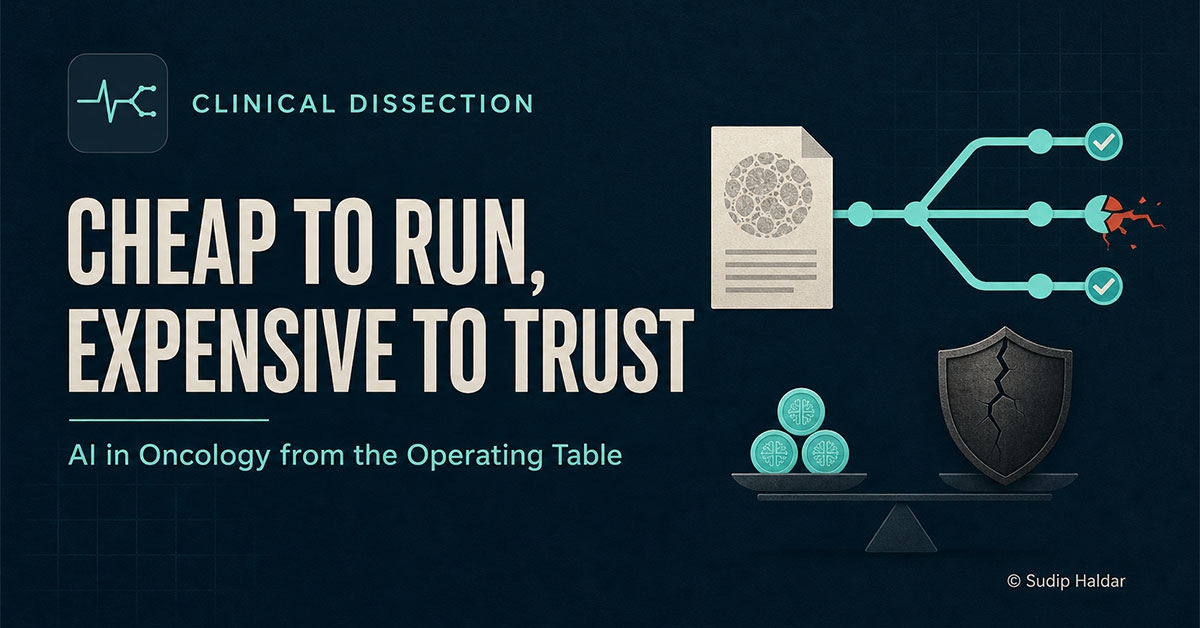



Clinical Dissection - AI in Oncology from the operating table: Dr Sudip Haldar | Shankus Cancer Hospital, Patan, Gujarat
Dissecting: Equity and Automation in Clinical Trial Screening (Lewis et al., JCO Clin Cancer Inform, 2026)
The Case That Started It
A farmer in his late fifties from a village near Patan initially presented at an outside centre experiencing weight loss and vague abdominal discomfort. There, endoscopy and biopsy confirmed a non-obstructing adenocarcinoma of the gastric body. Following significant clinical improvement after four cycles of neoadjuvant FLOT, he was referred to me for surgical evaluation. After reviewing his external imaging and restaging the disease, I performed a radical gastrectomy in the operating theatre; he subsequently completed his adjuvant chemotherapy regimen with us and transitioned into routine follow-up care.
Sixteen months in, he came back with abdominal pain and anorexia. A PET-CT showed a new liver lesion. Before we can discuss a targeted option - or a trial - he needs a biopsy and PD-L1 testing. That report will come back the way every outsourced report does here: a scanned PDF, sometimes a photograph of a printed page, filed as an image, never as a structured, searchable result. His follow-up notes tell the same story from the other direction - performance status is rarely recorded at every visit, and nobody is charting his weight trend. However, both would matter more to a matching algorithm than most of what's already in his file. Biologically, he may be a strong candidate for a PD-L1-driven trial. On the actual paper his PD-L1 result is printed on, no matching system would ever find him.
Why This, Why Now
Why Lewis et al. matters in a setting it never mentions
Published July 7, 2026 - two days before I started writing this. It will circulate quickly in oncology-AI circles over the next fortnight, get nodded at, and then get closed. The part that's missing isn't the argument itself - that's solid - it's the boundary of the argument. Lewis et al. map three compounding equity risks in AI-enabled trial matching: who can afford to deploy these systems, whose data trains them, and who's watching. Every fix they propose - cooperative-group leverage, national infrastructure, funder-mandated validation - assumes a level of infrastructure that exists in the US and nowhere I currently practice. That gap is worth naming before this paper becomes background noise everyone agrees with, and nobody interrogates.
The Paper at a Glance
- Citation: Lewis KA, Seldomridge AN, Helmink BA, Lyu HG, Snyder RA. Equity and automation in clinical trial screening: risks and responsibilities of artificial intelligence-enabled matching and enrollment systems. JCO Clin Cancer Inform. 2026;10(3):e2600032. DOI: 10.1200/CCI-26-00032 (ASCO/JCO CCI).
- Study design: Commentary/opinion piece; no primary data collected.
- Population: N/A; narrative synthesis of roughly 20 cited sources across oncology and general AI-equity literature.
- AI methods: The full spectrum of AI-enabled matching and enrollment systems (AIMES) - rule-based/NLP EHR extraction, open-source LLM reasoning (e.g., TrialMatchAI), proprietary vendor-hosted oncology-specific LLM (e.g., OncoLLM).
- Primary claim: AIMES deployment is outpacing equity validation in oncology trial screening - a claim argued, not measured, in this commentary.
- Key number: Of seven trial-matching systems in a cited 2023 meta-analysis, only one reported patient race or ethnicity. Elsewhere, among 692 FDA-approved AI health tools reviewed, fewer than 1% reported any socioeconomic information in their test datasets.
- Source: JCO Clinical Cancer Informatics (ASCO), peer-reviewed commentary, open access.
What a Surgeon Actually Sees in Practice
Strip away the framing, and Lewis et al. are doing something useful: mapping how three risks in AI trial matching compound rather than sit in parallel. Infrastructure decides who can deploy. Data decides who the deployed system serves well. Oversight decides whether anyone notices the gap before it scales. That structure is the paper's real contribution, and it holds up.
What it doesn't quite do is answer the question it sets out to answer. It frames itself as an equity paper. But its idea of underrepresentation is bounded by a very specific geography - academic centres versus community practices, insured patients versus Medicaid, all within one health system. LMICs never appear. Not once, not even as a footnote. For a paper that spends four pages worrying about who gets left out, that is itself worth noticing.
The clinical scenario where this would change something for me hasn't happened yet - as far as I'm aware, no AIMES is running at most centres I know in Gujarat. But the logic transfers immediately, because CROs and trial sponsors already use AI-driven identification to decide where to open sites and which patients to approach globally. The paper's central worry - "documentation bias," where language like noncompliant gets encoded into the system as clinical fact - is a rich-data problem. It assumes there's enough text to be biased. My patient's problem is the opposite: not biased documentation, but the near-total absence of structured documentation. His PD-L1 result exists. It's real; it says something true about his tumour. It simply isn't machine-readable, because it arrived as a photograph of a printed page. No AI reads that as a false negative. It reads it as nothing - which is worse, because "nothing" doesn't trigger review, doesn't get flagged, doesn't generate an alert. It just quietly excludes him.
Before I could trust an AIMES to evaluate clinical trial eligibility for my patients, I would require equity-stratified validation data that explicitly include non-EHR-linked individuals, rather than just race- and ethnicity-subgroups extracted from a single integrated healthcare system. We need data on a distinct subgroup: those whose record arrived on paper. Until that specific metric is published, it remains entirely unclear how these platforms handle my patients-an uncertainty I suspect the authors share.
Wait - Read the Methods
This is a commentary, not a study - no new data, no cohort, no statistical analysis. That's fine; commentaries earn their keep through argument, not p-values. But it's worth knowing what the argument leans on before you carry it into your own reading. The claim that "equity-focused AI design produces measurable gains" rests on two citations - a trial site-selection model and a federated transfer-learning study - that the authors themselves describe as "neither AIMES validation studies nor oncology specific." Named plainly, not as a gotcha: the strongest evidence for optimism in this piece is borrowed from adjacent fields, not drawn from oncology trial-matching itself.
Second thing worth flagging: the disclosure-gap statistic - only one of seven trial-matching systems reporting race or ethnicity - comes from a meta-analysis published in 2023, while the infrastructure section of this same paper spends most of its energy on LLM-based systems that either didn't exist yet or were early prototypes at that point. The evidence describing the transparency gap predates much of the technology it describes - a reminder that in a field moving this fast, even a paper published last week may be citing evidence that is already ageing.
What this means for how much to trust the piece: trust the structural logic - infrastructure, data, and oversight risks compounding on each other - more than any single number attached to it. That logic is durable. It's also, as the next section shows, exportable well beyond the setting the authors had in mind.
Does This Work Here?
Lewis et al. wrote this for a US health system, weighing academic centres against community practices. They had no reason to write about India - that was never their brief, and holding a US commentary to a global standard it never claimed would be a lazy critique. What's more useful is taking their three-domain framework - infrastructure, data, oversight - and running it one level further down the resource gradient than they did, to see what it reveals and, more importantly, what's already being done about it.
Access. As far as I'm aware, no AIMES is deployed anywhere I practice, and the two paths the paper describes both assume starting points we don't have. A proprietary vendor-hosted LLM assumes a dedicated informatics budget; an open-source model assumes an in-house data science team to run it. The honest starting point for India isn't choosing between those two; it's building toward shared, lower-cost tooling designed for exactly this resource band from the outset, rather than importing a scaled-down version of a US product.
Infrastructure. Most of the oncology setups I interact with across India lack EMR/EHR and PACS. Imaging exists as typed or handwritten reports, not as structured, linkable files. Molecular and biomarker testing is routinely outsourced and returns as a scanned PDF or photographed printout - the "external lab result invisible to AIMES" scenario the paper raises as a hypothetical is, here, the default rather than the edge case. This is precisely the gap the National Cancer Grid's EMR initiative was built to close - 216 standardised requirements across more than 360 centres in the Grid, tiered by resource level - which means the fix isn't theoretical; it already has a name and a national sponsor.
Data. No Indian or South Asian patients appear in any training or validation set cited in this paper, or in the strongest independent validation study of a trial-matching AI I found while researching this issue. That's a real gap, but it's also the one item on this list within our own control - every registry, dataset, and validation study we generate locally (including the work behind this newsletter) is a direct contribution to closing it.
Regulatory. No specific CDSCO regulatory pathway yet exists for AI trial-matching or decision-support tools. The DPDP Act 2023 and its 2025 Rules impose real obligations - penalties of up to ₹250 crore for failing to implement reasonable security safeguards - on any hospital that pools patient data to train or validate a matching system. Read as a constraint, that's a burden. Read as a forcing function, it means any AIMES built for India will have to design consent and governance from day one rather than retrofitting them later, which is not the worst place to start.
Workforce. Almost no centre I know has dedicated clinical informatics staff to build, validate, or maintain even a rule-based screening tool, let alone an LLM pipeline. That's a capacity-building need, not a permanent ceiling - and it's a concrete argument for training pathways in clinical informatics alongside oncology training, not after it.
Extending the paper's own logic one step further: if global sponsors start using AIMES to decide where to open trial sites - based on which health systems already have matchable, digitised data - India risks exclusion from trial siting altogether, a harder equity failure than being matched less accurately inside a system you're already part of. The way to stay off that list isn't to wait for someone else to fix it; it's what the next section lays out.
Verdict: Not For This Setting when evaluating the tools as they stand today. However, it remains Adoptable With Conditions regarding the underlying principle. We must prioritize building structured data capture immediately to prevent a circumstantial exclusion from becoming a permanent barrier.
The Real Experiment
If I wanted to test this, I wouldn't start by designing a new data-capture format. The National Cancer Grid already did that work - 216 finalised requirements across more than 360 Indian cancer centres, tiered Silver, Gold, and Platinum by resource level, built on FHIR for interoperability, developed specifically because EHR products designed for high-income systems don't fit LMIC workflows. What I'd measure is whether adopting the NCG's Silver-tier requirements changes anything real. First, the proportion of my patients for whom outsourced biomarker results - PD-L1, HER2, MMR - can be captured as structured fields rather than scanned images. Second, the time from an outsourced report landing on my desk to its becoming searchable data. Third, hypothetically, what fraction of my recurrence patients would become "visible" to a trial-matching algorithm before structuring versus after. My prediction: a meaningful share of biologically eligible patients are currently invisible to any matching logic - not because they're ineligible, but because of file format. That's a bias category this paper never names. Call it data-format bias - upstream of anything an algorithm ever gets the chance to decide.
The Verdict
The paper is right that AI-driven trial matching risks concentrating access among patients who already have it. It doesn't look far enough to see that some health systems aren't in that risk calculation at all - we're not on the map yet. Fix the data format before you fix the algorithm. An AI can't misclassify a patient it never sees.
Next Issue + Reader Question
Reader question: If your centre outsources molecular testing, how many of those reports live only as PDFs or images? What would it actually take to structure them? Write in - I'd like to know how widespread this is.
Next issue: Parkinson et al., "Artificial Intelligence in Oncology: Clinical Applications, Challenges, and Opportunities" (ASCO Educational Book, 2026). The easy version of that dissection would be tool-by-tool - which platform needs which scanner. The real question is bigger than any single tool: the paper offers a five-question framework for deciding whether any AI tool belongs in your clinic, and it builds toward the idea of the "digital twin" - a virtual patient continuously updated by real clinical data. Both assume a continuity of data that Issue #1 already showed we can't assume here.
Sources Cited in This Issue
- Lewis KA, Seldomridge AN, Helmink BA, Lyu HG, Snyder RA. Equity and automation in clinical trial screening: risks and responsibilities of artificial intelligence-enabled matching and enrollment systems. JCO Clin Cancer Inform. 2026;10(3):e2600032. doi:10.1200/CCI-26-00032.
- Loaiza-Bonilla A, Yost C, Kurnaz S, et al. Transforming oncology clinical trial matching through neuro-symbolic, multi-agent AI and an oncology-specific knowledge graph: a prospective evaluation in 3804 patients. ESMO Real World Data Digit Oncol. 2026;12:100706. doi:10.1016/j.esmorw.2026.100706.
- Pramesh CS, Koita R, Sengar M, et al. National Cancer Grid initiative for electronic medical records, India. Bull World Health Organ. 2025;103(5):337-342. doi:10.2471/BLT.24.292230.
- Digital Personal Data Protection Act, 2023, and Digital Personal Data Protection Rules, 2025 (Government of India) - penalty schedule under Section 8(5).