

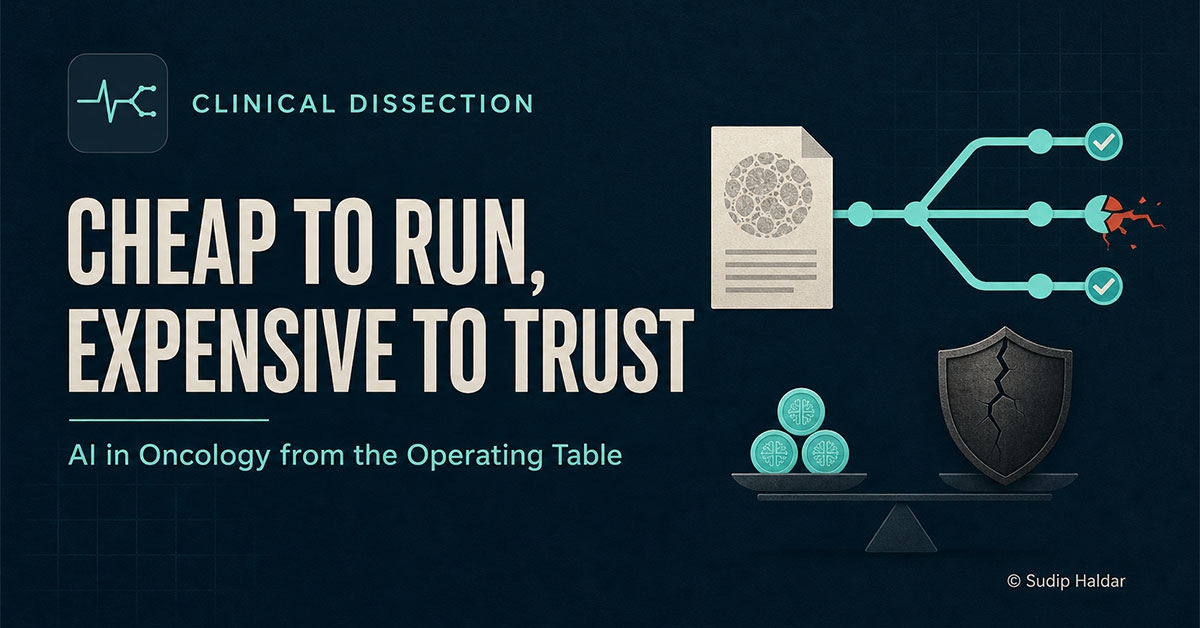
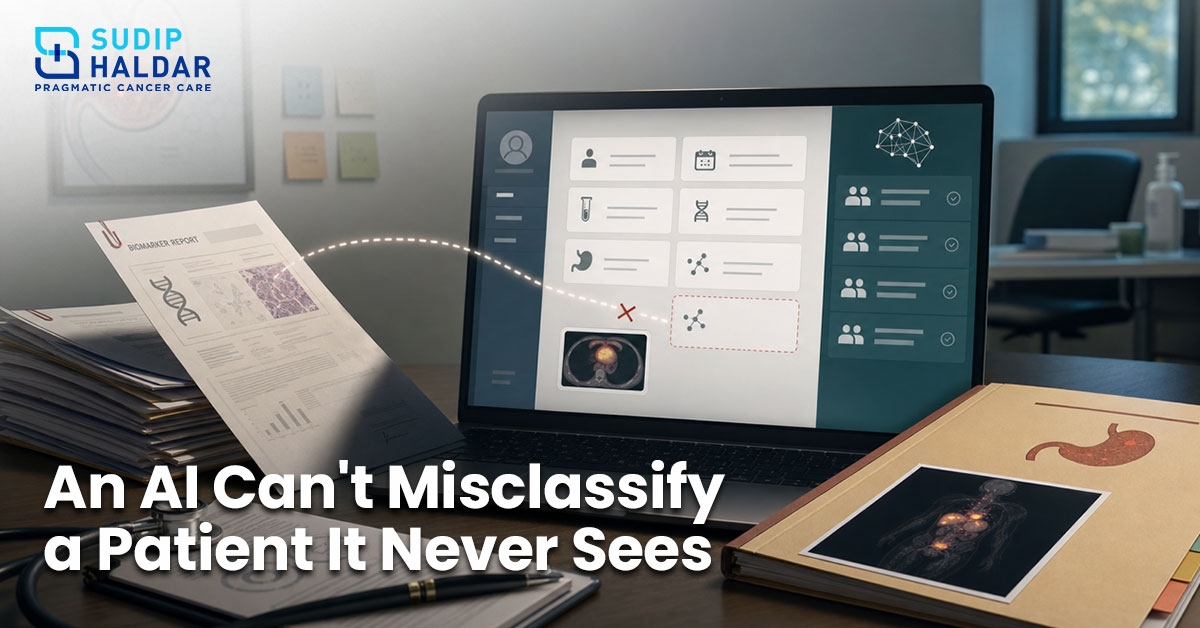


Clinical Dissection - AI in Oncology from the operating table Dr. Sudip Haldar | Shankus Cancer Hospital, Patan, Gujarat
Dissecting: Artificial Intelligence in Oncology: Clinical Applications, Challenges, and Opportunities (Parkinson et al., ASCO Educational Book, 2026) [1] - read alongside ASCO's own six-principle AI governance framework [2]
ASCO's document calls these "principles"; this issue reframes them as "pillars" for the load-bearing metaphor used throughout - an interpretive choice, not ASCO's own term.
1. The Case That Started It
A 45-year-old woman from Patan came to me two weeks after an excision done elsewhere. The lump had been presumed a fibroadenoma - no core biopsy, no imaging workup, no plan for what to do if it wasn't. It wasn't. She arrived with a residual mass under the scar and a firm 2 cm node in her axilla that no one had examined before that first cut. Her outside histopathology, read only after the fact, showed strongly ER-positive, PR-positive, HER2-negative disease. PET confirmed no distant spread - locoregional disease, still curable, but the sequence that should have decided her treatment had already been decided for her, by a surgery that never asked the question it needed to. Neoadjuvant chemotherapy, which might have used her intact tumour as a live readout of drug sensitivity, was no longer available to me - that tumour bed was gone before I ever saw her. I chose completion surgery: her biology was hormone-driven, unlikely to respond dramatically to chemotherapy first, and what she needed now was margins and nodal staging, not a second experiment.
2. Why This, Why Now
ASCO's six AI principles [2] have been read and cited since May 2024, and they deserve more credit than they usually get. The review built around them borrows a useful diagnosis from earlier oncology-AI literature [5,6]: that deployment risk is sociotechnical, not purely algorithmic. ASCO isn't alone in this structure: WHO's own six ethical principles for health AI (2021), later extended to generative and multimodal models (2024), face the identical translation problem at a global scale [3,4]. What's changed by mid-2026 is that we can finally measure what it takes to build under that diagnosis - independent hospital audits [10,12] now show exactly how much construction implementation needs to catch up with the framework. Parkinson et al.'s review [1] - arguably the most complete MMAI survey published this year - catalogs the tools these principles are meant to support, end to end. This is the first fortnight the pillars and the construction data underneath them have sat on the same desk.
3. The Paper at a Glance
- Citation:Parkinson G, Patel R, Bergstrom C, et al. Artificial Intelligence in Oncology: Clinical Applications, Challenges, and Opportunities. Am Soc Clin Oncol Educ Book. 2026;46:e520716. DOI: 10.1200/EDBK-26-520716 —[1] Companion source: ASCO. Principles for the Responsible Use of Artificial Intelligence in Oncology (2025 update) [2]
- Study design:Narrative review / clinical education perspective - not primary research
- Population:N/A (review). Spans studies from N=134 (DELFI, ovarian-cancer-case subset of a 541-patient validation cohort: 134 cancer, 204 healthy, 203 benign) to N=16,000 biopsies (ArteraAI phase III cohorts) across breast, prostate, lung, pancreatic, and ovarian cancer
- AI method:Multimodal AI (MMAI) spanning the full diagnostic-to-monitoring pipeline - radiomics (MERLIN, UMBIF), pathomic genomic-inference from routine H&E (Orpheus, Stratipath, RlapsRisk, HEX), and dynamic ctDNA monitoring (CANSCAN, DELFI) - unified under a six-principle governance model
- Primary outcome:Not a measured clinical endpoint. The paper's "outcome" is the governance framework itself: transparency, informed stakeholders, fairness, accountability, oversight & privacy, human-centered application
- Key result:No single number in the paper - so here's the number that actually tests its claim: a 2025 national survey found roughly two-thirds of US hospitals use predictive AI, but among those users only 61% audit for accuracy and just 44% for bias with their own data [10,12]. That's the empirical yardstick for whether "principles" become practice.
- Journal/source:ASCO Educational Book, peer-reviewed, published May 2026, open access
4. What a Surgeon Actually Thinks
The review earns its central claim - treating deployment risk as sociotechnical rather than purely algorithmic, borrowed as that framing is [5,6] - by building genuinely well-validated architecture underneath it. Here's what that architecture actually contains, before I get to where my own patient breaks it.
The journey this paper actually maps
Start where oncology always starts: clinicopathologic factors - nodal status, tumour size, grade, ER/PR/HER2 - still prognostic, still the backbone. The 21-gene Oncotype recurrence score built on top of them carries level 1A evidence (TAILORx, RxPONDER) for guiding chemotherapy in ER-positive, HER2-negative disease. Nothing that follows displaces that foundation; it either sharpens what's already being measured or measures something genuinely new.
Radiomics is the first sharpening. Routine CT/PET/MRI reads have historically meant a single-slice tumour diameter or a maximum tracer-uptake value - a highly simplified number standing in for a genuinely complex tumour. Foundation models like MERLIN (3D CT, AUROC 0.757 for five-year multidisease prediction) and UMBIF (51,029 MRI scans, AUC up to 0.916 for molecular markers like 1p/19q codeletion) replace that single number with a full quantitative read of a scan the patient already had.
Then comes the layer I find most persuasive, economically. An Oncotype recurrence score costs thousands of dollars and days to weeks to return. Orpheus infers the same recurrence-score category from an H&E slide that's already being cut and stained for every patient anyway, at an AUC of 0.89 for high-risk disease against 6,172 validation cases - beating a leading clinicopathologic nomogram (0.73). Stratipath Breast (HR 2.2 for recurrence in grade-2 ER+/HER2- disease, 2,719 validated patients) and RlapsRisk BC (C-index 0.81 versus 0.76 for clinicopathologic factors alone, beating both EndoPredict and the 21-gene RS directly) tell the same story with different numbers, and the Bidard et al. model - validated in 633 high-risk patients from CANTO and UNIRAD — found a distant recurrence-free interval hazard ratio of 0.21 for its low-risk group. None of these tools invent new biology; they extract biology that was already sitting in the slide, at the cost of a slide rather than the cost of a genomic assay. That's the actual bridge - not new information, cheaper access to information that already exists. HEX does the identical thing one layer down, inferring spatial-proteomic biomarker expression directly from routine H&E; the paper itself calls it "a low-cost, scalable strategy" to recover spatial biology without a dedicated platform.
The same logic solves a different problem: not cost, but speculation. PD-L1 immunohistochemistry has a documented reliability problem - clonal heterogeneity, weak and inconsistent expression, real disagreement between readers. Quantifying tumour-infiltrating lymphocytes and immune architecture from the same slide replaces one subjective stain read with a multi-feature quantitative one. Less guessing, not just less cost.
What none of this - pathomic or radiomic - can do is move. A slide and a scan are both static: a single frame from whichever day the sample was taken. ctDNA is the one genuinely dynamic signal in the whole review, tracking minimal residual disease, molecular response, and clonal evolution over time in a way nothing built from a fixed image can. CANSCAN shows how far this has come: 87.4% sensitivity and 97.8% specificity across 13 cancer types in independent validation, with a 15,000-patient prospective screening cohort now planned. DELFI beat CA125 alone at every stage of ovarian cancer, including stage I detection (69% versus 40%), at over 99% specificity. It's a genuinely improving, encouraging trajectory - though not a uniform one: Galleri's NHS trial missed its primary endpoint of reducing stage III-IV diagnoses, a reminder that dynamic doesn't yet mean solved. The paper's own proposed next step is the obvious one: fuse the static architecture - pathomics, radiomics - with the dynamic signal, into one longitudinal read of the same patient. That fusion is, functionally, what MMAI is supposed to mean.
Where my patient breaks it
My patient didn't enter there. By the time I saw her, someone had already decided her lump was a fibroadenoma and removed it accordingly - no core biopsy, no imaging, no frozen section, no axillary look. Every tool in the journey above, from Orpheus inferring a recurrence score off an H&E slide to the transformer models predicting pathologic complete response from pretreatment biopsies, needs exactly the specimen she no longer had. ArteraAI's breast platform is validated on 8,161 patients from cooperative trials where sequence and specimen integrity were protocol-guaranteed. Hers wasn't guaranteed by anyone.
As a data scientist, this is a distribution-shift question the review doesn't yet ask: every model it discusses was trained and tested on patients who entered oncologic care through an oncologic door. A meaningful fraction of my patients enter through a general-surgery door, on a benign working diagnosis, and the AI literature has nothing to say about that population yet - because it was excluded at the sampling stage, not misclassified at the inference stage.
As a surgeon, the decision I actually had to make - surgery first, given hormone-driven biology, over neoadjuvant chemotherapy, given the tumor bed was already gone - didn't touch a single tool in this paper. It was pattern recognition and biology, the same decision oncologists made before any of this existed.
That's the next pillar to pour, not a crack in the six that already stand. "Human-centered application" and "informed stakeholders" extend naturally to the moment before the first cut - they just haven't been built out that far yet, and Patan is as good a place as any to start pouring that foundation.
5. Wait - Read the Methods
This is a review, not a trial, so there's no p-value to interrogate - but one attribution deserves precision. Parkinson et al. credit the sociotechnical framing of AI risk to earlier oncology-AI reviews [5,6], not original analysis of their own. The diagnosis is correct; the operational layer specific to oncology pipelines is simply missing - and ASCO isn't alone in leaving it implicit. WHO's own six principles [3,4] carry the identical gap globally.
That layer exists elsewhere, mostly outside oncology. Solaiman et al. [7] propose a lifecycle model spanning development through post-deployment monitoring and de-implementation - general healthcare-AI governance, not built for oncology specifically. Hasan et al. [8] map eight regulatory frameworks onto 31 operational best-practice guides. Hamamoto et al. [9], writing in a precision-oncology context the same month as Parkinson et al., specify one worked example of the missing scaffolding - RAG-grounded retrieval, human-in-the-loop workflows, OMOP/mCODE/FHIR alignment - not the only one.
What this means: read the six principles as architecture, not a finished building - the construction manual exists, just attached to different papers. For scale: Nong et al. [10] found roughly two-thirds of US hospitals use predictive AI, yet among those users only 61% evaluate for accuracy and 44% for bias with their own data; a 2025 federal follow-up [12] found both rates improving by 2024 but still short of universal auditing. That's the normal baseline for construction, before you even reach a different foundation like Patan's.
6. Does This Work Here?
The Parkinson review is written for a US regulatory environment - FDA clearances, NCCN guidelines, phase III cooperative trials. It never claims to speak to Patan, and it shouldn't be faulted for that. The question is what happens when you extend its framework one step further down the resource gradient - into a tier-2/tier-3 Indian city, not "India" treated as one undifferentiated setting.
Access. ASCO's six principles cost nothing to read and nothing to apply as a discussion checklist at tomorrow's tumour board - no license, no vendor. A real, immediate win.
Infrastructure. Every tool in this review assumes a digitized, queryable imaging and pathology pipeline. National Cancer Grid data shows most Indian PACS deployments still function only as archives, not as AI-ready data sources - the infrastructure "transparency" and "oversight" presuppose doesn't yet exist at most centres, including many NCG-affiliated ones.
Data. None of the named oncology tools - Orpheus, Stratipath, ArteraAI, HEX, CANSCAN, DELFI - trained on an Indian cohort. Worth saying plainly rather than assuming. The nearest counter-example isn't oncology: Hamamoto et al. [9], reproducing figures from Tanno et al.'s Flamingo-CXR study [13], report that a panel of 27 board-certified radiologists from the US and India evaluated report generation on Indian inpatient/outpatient data (the IND1 dataset), with a collaborative AI-plus-physician workflow reaching 71.2% favourable/equivalent ratings versus 51.2% for AI alone. It's chest X-ray, not cancer, and this account is one step removed from Tanno et al.'s own text - but it demonstrates the validation pathway exists. Nobody has walked it yet for the tools this review actually catalogues.
Regulatory. Moving faster than expected: CDSCO's October 2025 draft guidance [14] now explicitly covers AI/ML software as a medical device, with a defined Algorithm Change Protocol, and AI cancer-detection software was classified Class C in January 2026. ASCO's "accountability" principle finally has a regulatory hook to attach to here, now.
Workforce. "Oversight" assumes someone's job is to audit the model. At most semi-urban centers, that role doesn't exist yet - it's absorbed informally by whoever reads the report.
Equity implication. The NCG–IndiaAI CATCH programme [15] already has a 28-solution national compendium as of the 2026 India AI Summit. The scaffolding for a population-representative answer is being built — it's just not yet populated with data from patients like mine. The closest US analogue is instructive: Nong and colleagues [11], the same lead author behind the hospital-audit numbers above, separately argue that healthcare-AI governance frameworks built around well-resourced systems structurally under-represent safety-net institutions — the American setting closest in kind to a tier-2/tier-3 Indian hospital. Their fix is to centre under-resourced institutions in governance design from the outset rather than retrofit equity later, which is exactly the sequencing this section is arguing for.
Adoptable With Conditions - the six pillars are ready to anchor tomorrow's tumour-board discussion, today, at no cost. The audit mechanism and the local training data are the two pieces still under construction.
7. The Real Experiment
If I wanted to validate ASCO's six principles at Patan, I wouldn't start by testing a specific AI tool - I'd start by auditing the pipeline the tools assume exists. I'd use the Power BI surgical registry to tag every new breast cancer referral by entry point: direct oncologic presentation versus referred-in after an outside intervention, like hers. My working hypothesis is that a meaningful fraction of node-positive or upstaged referrals arrive with an already-compromised specimen - the same distribution-shift problem from Section 4, but measured, not asserted. Then I'd apply Nong et al.'s hospital audit methodology directly [10]: for whatever predictive or imaging AI is already quietly in use here, do we evaluate it locally for accuracy and bias - the way the Health Affairs data says most well-resourced US hospitals still don't? I suspect the honest answer, today, is no - and that's the baseline worth publishing before adopting anything new.
8. The Verdict
The diagnosis is right, borrowed or not: AI risk in oncology is sociotechnical, and six is the correct number of pillars. What's missing isn't a seventh - it's the audit trail under "oversight," and a foundation, starting in places like Patan, that reaches the moment before the first cut.
9. Next Issue + Reader Question
Reader question: How many of your own referred-in cases would already fail the "clean specimen" assumption baked into every AI model you've read about this year?
Next issue: an agentic AI system that browses, plans, and calls tools like a junior colleague - benchmarked against a plain LLM, it costs up to 100× the compute for single-digit accuracy gains, with hallucinations still shaping roughly a third of cases. We test what "agentic" is actually buying you.
Sources Cited in This Issue
- Parkinson G, Patel R, Bergstrom C, Vadasz B, Amgad M, Cooper LAD, Sparano J, Lu J. Artificial Intelligence in Oncology: Clinical Applications, Challenges, and Opportunities. Am Soc Clin Oncol Educ Book. 2026;46:e520716. doi:10.1200/EDBK-26-520716.
- American Society of Clinical Oncology. Principles for the Responsible Use of Artificial Intelligence in Oncology. Alexandria (VA): ASCO; 2025 [updated 2025 May]. Available from: https://cdn.bfldr.com/KOIHB2Q3/as/g5jsnp7g2b6m28j67j97smff/2025-ASCO-AI-Principles
- World Health Organization. Ethics and governance of artificial intelligence for health. Geneva: WHO; 2021. ISBN 9789240029200.
- World Health Organization. Ethics and governance of artificial intelligence for health: guidance on large multi-modal models. Geneva: WHO; 2024. ISBN 9789240084759.
- Lotter W, Hassett MJ, Schultz N, et al. Artificial intelligence in oncology: Current landscape, challenges, and future directions. Cancer Discov. 2024;14:711-726.
- Luchini C, Pea A, Scarpa A. Artificial intelligence in oncology: Current applications and future perspectives. Br J Cancer. 2022;126:4-9.
- Solaiman B, Mekki YM, Qadir J, Ghaly M, Abdelkareem M, Al-Ansari A. A "True Lifecycle Approach" towards governing healthcare AI with the GCC as a global governance model. NPJ Digit Med. 2025;8:337. doi:10.1038/s41746-025-01614-1.
- Hasan A, Prizant N, Kim JY, Rao S, Vidal D, Shaw K, Tobey D, Valladares A, Zilberstein S, Patel M, Balu S, Sendak M, Lifson M. Aligning AI principles and healthcare delivery organization best practices to navigate the shifting regulatory landscape. NPJ Digit Med. 2025;8(1):278. doi:10.1038/s41746-025-01605-2.
- Hamamoto R, Koyama T, Takahashi S, Yasuda T, Kobayashi K, Akagi Y, Kouno N, Sudo K, Hirata M, Sunami K, Kubo T, Katayama H, Takashima A, Taniguchi T, Matsumoto H, Shibaki R, Asada K, Komatsu M, Kaneko S, Yamada M, Horinouchi H, Tanaka K, Goto Y, Kato K, Saito Y, Nakamura K, Yamamoto N. Implementing generative artificial intelligence in precision oncology: safety, governance, and significance. J Hematol Oncol. 2026;19:14. doi:10.1186/s13045-026-01781-y.
- Nong P, Adler-Milstein J, Apathy NC, Holmgren AJ, Everson J. Current Use and Evaluation of Artificial Intelligence and Predictive Models in US Hospitals. Health Aff (Millwood). 2025;44(1):90-98. doi:10.1377/hlthaff.2024.00842.
- Nong P, Maurer E, Dwivedi R. The urgency of centering safety-net organizations in AI governance. NPJ Digit Med. 2025;8(1):117. doi:10.1038/s41746-025-01479-4.
- Chang W, Owusu-Mensah P, Everson J, Richwine C. Hospital Trends in the Use, Evaluation, and Governance of Predictive AI, 2023-2024. ASTP Health IT Data Brief No. 80. Washington (DC): Office of the Assistant Secretary for Technology Policy; 2025 Sep.
- Tanno R, Barrett DGT, Sellergren A, Ghaisas S, Dathathri S, See A, Welbl J, Lau C, Tu T, Azizi S, Singhal K, Schaekermann M, May R, Lee R, Man S, Mahdavi S, Ahmed Z, Matias Y, Barral J, Eslami SMA, Belgrave D, Liu Y, Kalidindi SR, Shetty S, Natarajan V, Kohli P, Huang PS, Karthikesalingam A, Ktena I. Collaboration between clinicians and vision-language models in radiology report generation. Nat Med. 2025;31(2):599-608. doi:10.1038/s41591-024-03302-1.
- Central Drugs Standard Control Organisation. Draft Guidance Document on Medical Device Software. New Delhi: CDSCO; 2025 Oct 21.
- National Cancer Grid, IndiaAI Mission. From Innovation to Impact: Scaling Trusted AI for Cancer Care - IndiaAI-NCG Cancer AI & Technology Challenge (CATCH) Compendium. Presented at: India AI Summit 2026; New Delhi.